Posts in Category: Reflections
Reflection #5

In today’s class, we discussed online learning and its benefits and drawbacks. My group and I had a great discussion about online learning, and we had differing opinions, as many of us were forced online during the pandemic.
In my first year of University at Uvic, I did my schooling entirely online, synchronously. My major was Theatre, so you can imagine how insane it was to try and do acting class or lighting design over Zoom. The department adapted as well as they could under the circumstances, but I remember grieving the loss of my first year of university experience. I struggled to make connections and friendships because of the isolation, and I don’t think my relationships with my peers ever deepened, even when we moved back to in-person instruction in my second year.
However, there were parts of online learning that I loved: the comfort of my home, the flexibility, and the time saved from driving/bussing to or walking across campus. One great thing that came from the pandemic’s online schooling was that, in my second year, even though we had moved back to in-person, my classes also had the option to meet online, and many professors recorded their lectures and uploaded them. I wish this method of instruction had stuck around, as it would be so useful in the case of illness, but unfortunately, it seems in-person instruction has returned to how it was pre-pandemic.
Reflection #4
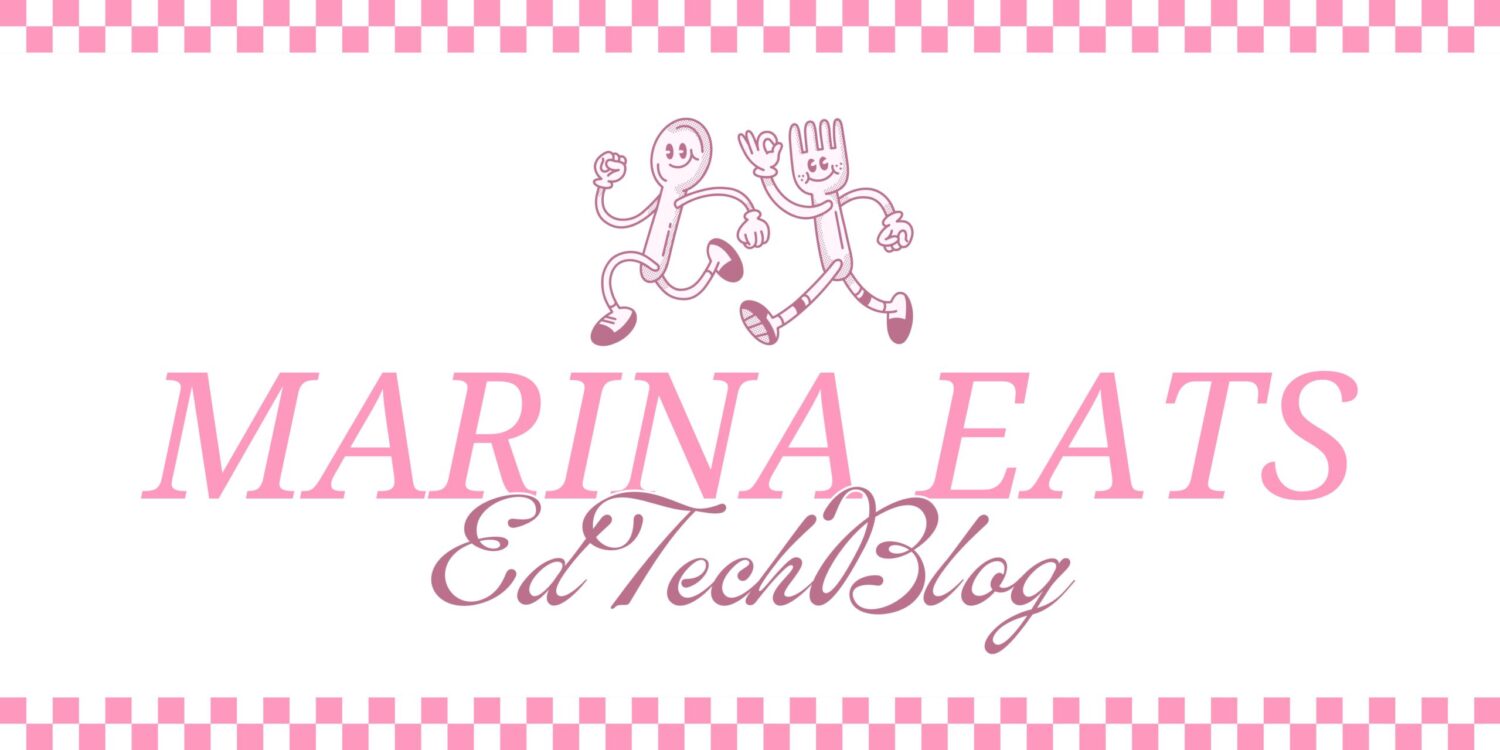
This week, we made banners for our blogs. I tried to use Microsoft designer to generate an AI image for mine, but I didn’t like how they looked, and I’m also not an AI art fan, because of the unliscensed use of artists work to train the AI models. Moreover, they often have a strange or uncanny appearance that I don’t enjoy. I used Canva to create a banner for my side heading as well as headings for my different posts to show which post is which. While I did not explicitly use AI for my banner design, and instead used a template from Canva, it is true that there is a chance that the images (the fork and spoon) in my design may be AI generated, as Canva does not specify which of their “elements” are AI generated and many of them are. For the post headers, I did not use a template and just created them using different elements and tools on Canva. Something I love about creating graphics on Canva is that you have complete creative control over the design, and you can make it fit with any vibe. For mine, I wanted to create a cartoonish, retro look, as I think the whimsical aesthetic fits the colourful and lighthearted nature of my blog.
Reflection #3
For this week I’ve embedded a screen recording I made and interacted with using H5P. I noticed I was getting frustrated easily with H5P as it was unfamiliar to me, and often when instructions are written I struggle to understand how to implement them. However, I tried my best and was eventually able to figure it out. I decided to make my video about how to use the website and app Trello, that I personally use for my own to do lists. I hope others will find this short tutorial helpful!
Video embedded and created by me.
Reflection #2

This morning, we discussed the SAMR technological integration model. SAMR stands for Substitution, Augmentation, Modification, and Redefinition. In our pod groups, we discussed examples of each in a classroom. Our group focused on elementary or middle school students and how SAMR can be used to integrate technology into their education in different ways.
Our group discussed that substitution could include allowing students to type their assignments rather than writing them; this substitutes typing for writing, offers no functional change, but may be easier for some students. Another example of substitution would be listening to an audiobook or reading an ebook on a tablet rather than reading a traditional paper book. Again, it is functionally the same, but technology gives us different avenues for reading; perhaps in an environment where some students benefit more from audio, or like ebooks so they can enlarge the text, substitution can help us incorporate UDL into our classrooms.
An example of augmentation we discussed was using text-to-speech to write; although it substitutes for writing with a pencil and paper, it can also create functional improvements for students who struggle with spelling or writing. I noticed that I struggle a little bit to find the line between substitution and augmentation, especially as it applies to inclusion or differentiation. I think the line between the two can blur, as it can with many levels of SAMR. However, I think this is inherent to technology integration; it can become a domino effect, where one incorporation leads to more, which leads to more improvements and functional changes in class.
The “no tech” phase has its place, as sometimes we want students to use paper and pencils and read traditional books; in math, especially at a young age, we want students to learn mental math before we allow calculators.
Class Reflection #1
In this class we discussed the benefits and problems of using inquiry based or project based learning (PBL). Benefits included the freedom to work on student individual interest and passion, which can create buy in and increase in motivation to learn. Moreover, PBL creates more space for creativity and critical thinking in the classroom, and helps students develop soft skills and social skills that may not be developed as greatly in a traditional school setting. However, many concerns with this model arise, such as how do students transition to traditional structures such as standardized testing, and does PBL set students up for success in the long run. My fiance attended PSII, an alternative high school here in Victoria, and he later switched schools to public school because the style of alternative education did not work for him; it required a lot of self motivation, and he wanted more structure. For this reason, I think sometimes students aren’t the right fit for alternative schools like High-Tech High or PSII, but I still believe PBL can be integrated in a hybrid fashion.
I am a huge believer in PBL, and many of my most memorable moments in grade school were PBL based. I always love incorporating art into my learning, and something I love about PBL is that students are given the freedom to use whatever medium they wish to communicate their learning. I believe PBL can be assessed in a more traditional way or using the proficiency scale. I love that PBL can be interdisciplinary, and I remember doing projects for all different subjects including literacy, math, socials and science.
I hope to integrate PBL into everyday teaching and curriculum in more traditional settings, as I’ve seen first hand that it is possible!